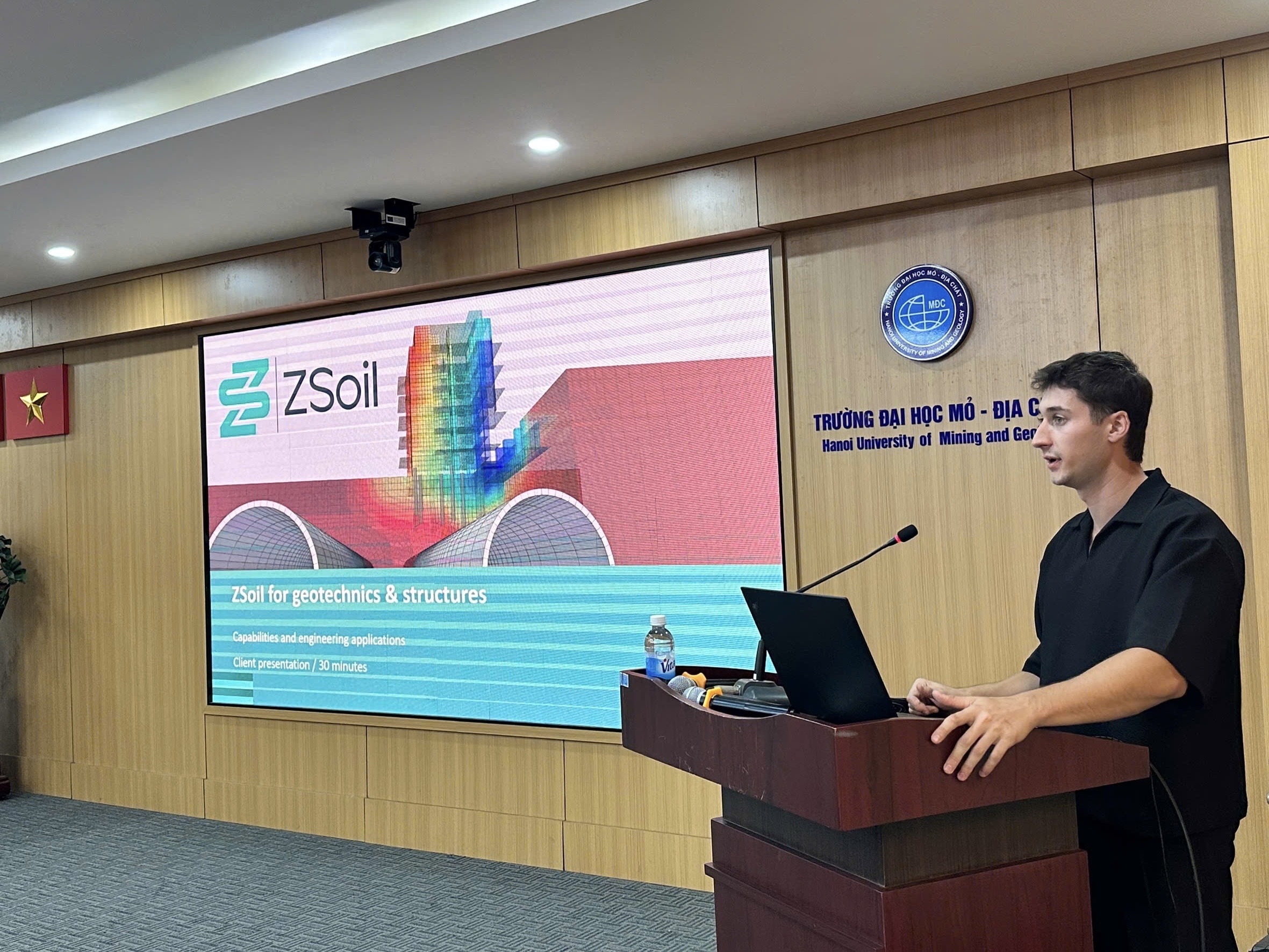
Geotechnical engineer Alexandre Lagrange presented applications of ZSoil in geotechnical and structural engineering, drawing on case studies from Switzerland
During his internship, Alexandre contributed to research on a proposed four-level underground parking facility near Tran Hung Dao Station in Hanoi. Under the supervision of Assoc. Prof. Dr. Dang Van Kien, he developed numerical models to compare the effects of different construction methods on the surrounding soil and adjacent structures. Assoc. Prof. Dr. Dang Van Kien still recalls Alexandre arriving at the laboratory at 8 a.m., approaching his research assignments with diligence and dedication. The research, involving collaborators from Viet Nam and abroad, was presented at the International Conference on Sustainability in Civil Engineering (ICSCE 2024) and published in the Journal of Materials and Engineering Structures, an international scientific journal currently indexed in Scopus and the Emerging Sources Citation Index (ESCI) of Web of Science.
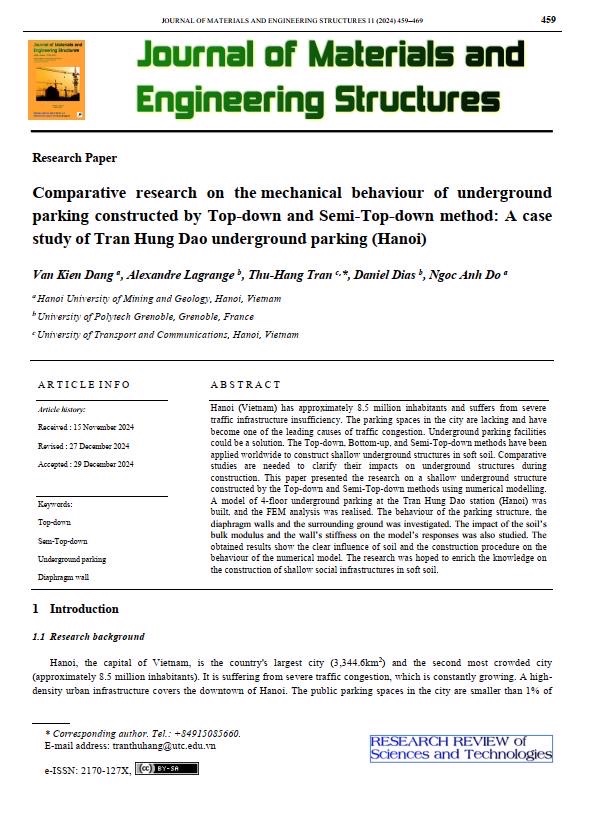
The research paper on underground parking construction near Tran Hung Dao Station in Hanoi, co-authored by Assoc. Prof. Dr. Dang Van Kien, Alexandre Lagrange and their collaborators, was published in the Journal of Materials and Engineering Structures in 2024
After completing his studies in France, Alexandre pursued a career in geotechnical engineering and now works at Karakas & Français SA, a Swiss engineering consultancy. There, he uses ZSoil to develop large-scale numerical models for engineering projects. Reflecting on his professional journey, Alexandre noted that Viet Nam was where he first gained experience using finite element analysis software, while his current work focuses on applying this type of engineering tool.

Alexandre Lagrange was pictured with Assoc. Prof. Dr. Dang Van Kien at Nam Mau Coal Company during his internship in 2024
In May 2026, Alexandre contacted Assoc. Prof. Dr. Dang Van Kien to arrange a return visit to Viet Nam and share the experience he had gained in professional practice. At a scientific seminar organised by the TUS Research Group of the Faculty of Civil Engineering in the Pho Yen Meeting Room, he delivered a presentation entitled "ZSoil – FEM for Geotechnics & Structures, Nonlinear FEA: Some Case Studies in Switzerland."
Drawing on engineering projects in Switzerland, including the CHUV Children's Hospital project and the LEB tunnel in the canton of Vaud, Alexandre demonstrated how ZSoil can be applied to geotechnical and structural analysis. His presentation focused on modelling construction stages, predicting ground deformation and assessing potential impacts on neighbouring structures. Simulation results help engineers evaluate construction methods, identify potential risks and make technical decisions suited to the specific conditions of each project. Through these case studies, the seminar offered HUMG lecturers and students insights into engineering consultancy practice in Switzerland, where numerical modelling is used to address real-world engineering challenges.
Reflecting on his internship, Alexandre expressed his appreciation for the warm welcome and support he received from HUMG lecturers, particularly Assoc. Prof. Dr. Dang Van Kien's dedication to sharing his expertise. He also fondly recalled the meals shared with HUMG lecturers during his time in Viet Nam. Returning two years later, he was delighted to share his professional experience and once again receive a warm welcome from the University.
Beyond the seminar, Alexandre also expressed his hope that lecturers and students of the Faculty of Civil Engineering would have greater access to ZSoil for teaching, learning and research. He intends to explore with his employer the possibility of supporting the Faculty with a software licence.
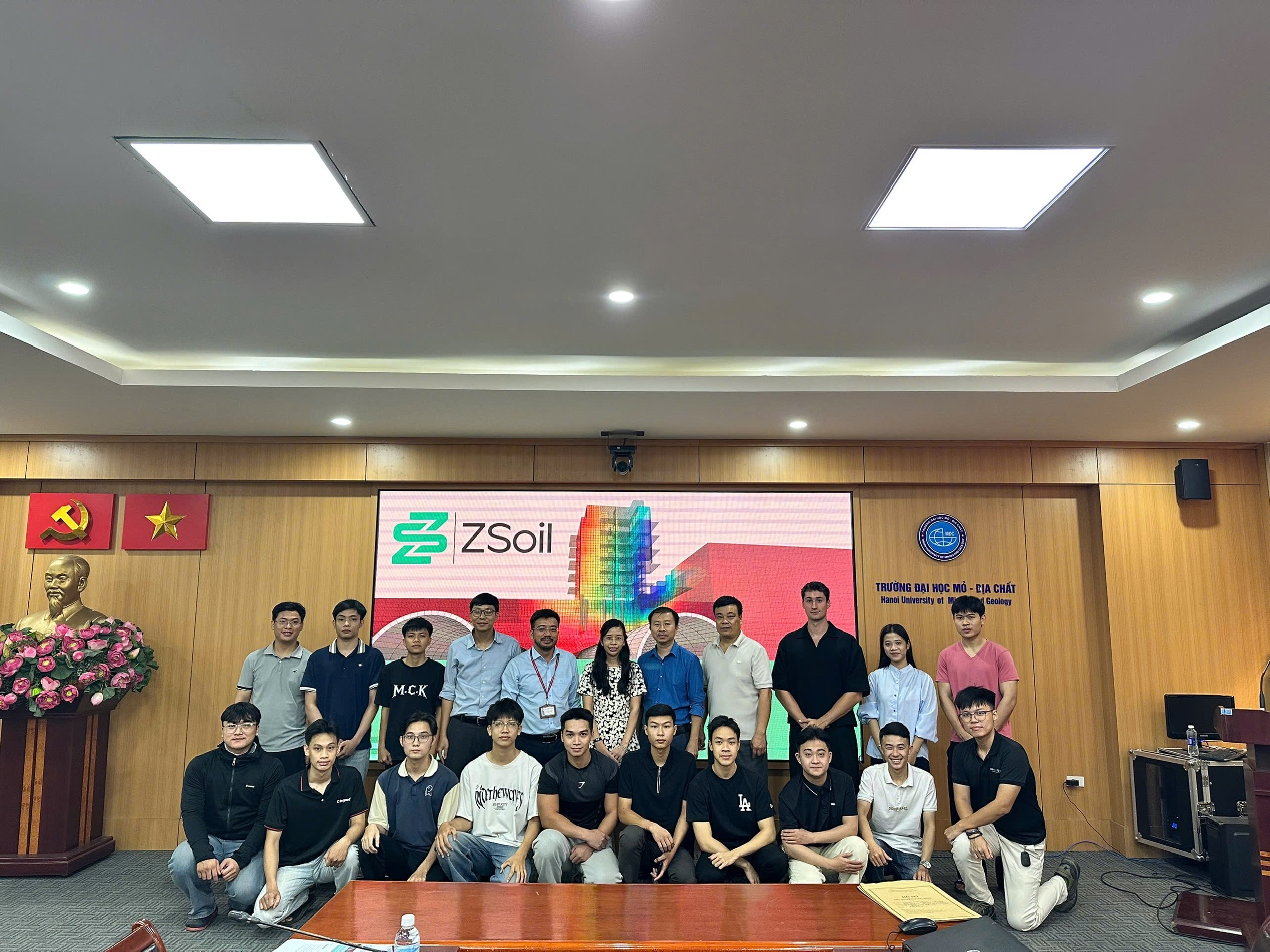
Alexandre Lagrange joined lecturers and students from HUMG's Faculty of Civil Engineering for a group photograph following the scientific seminar on 30 October 2026
An internship may last only a few months, but the research challenges and academic connections formed during that time can continue well beyond its conclusion. Experiences gained through research can help shape a professional journey, while knowledge and expertise developed through practice may eventually find their way back to the very place where that journey began.